Scholars’ Bank, an open-access digital repository created to capture, distribute and preserve the intellectual output of the University of Oregon. Scholars’ Bank is maintained by the University of Oregon Libraries, under the coordination of Metadata Services and Digital Projects. Over 4500 items now available in Scholars’ Bank. This will be added to Academic and Scholar Search Engines and Sources White Paper.
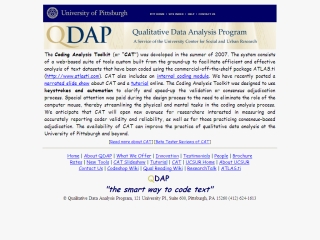
The Coding Analysis Toolkit (or “CAT”) was developed in the summer of 2007. The system consists of a web-based suite of tools custom built from the ground-up to facilitate efficient and effective analysis of text datasets that have been coded using the commercial-off-the-shelf package ATLAS.ti (http://www.atlasti.com). CAT also includes an internal coding module. They have recently posted a narrated slide show about CAT and a tutorial online. The Coding Analysis Toolkit was designed to use keystrokes and automation to clarify and speed-up the validation or consensus adjudication process. Special attention was paid during the design process to the need to eliminate the role of the computer mouse, thereby streamlining the physical and mental tasks in the coding analysis process. They anticipate that CAT will open new avenues for researchers interested in measuring and accurately reporting coder validity and reliability, as well as for those practicing consensus-based adjudication. This has been added to the tools section of Research Resources Subject Tracer™ Information Blog. This has been added to Script Resources Subject Tracer™ Information Blog.
OpenProj is a free, open source project management solution. OpenProj is a complete replacement of Microsoft Project and other commercial project solutions. The OpenProj solution has been download more than 200,000 times in the few weeks since launch and is being used in over 125 countries. OpenProj is ideal for desktop project management and is available on Linux, Unix, Mac or Windows. It even opens existing Microsoft or Primavera files. OpenProj shares the industry’s most advanced scheduling engine with Project-ON-Demand and provides Gantt Charts, Network Diagrams (PERT Charts), WBS and RBS charts, Earned Value costing and more. There is literally no time or effort involved in switching to OpenProj, and your teams can manage projects on any platform for free. Projity worked closely with leaders in the commercial and open source industries in preparation for the release of OpenProj. It is a welcome addition, not only for project management users, but also for users in all software segments. OpenProj fills an important gap in the desktop market, as a key component in the Office family of products now has a replacement available on Linux, Unix, Mac or Windows. OpenProj has been translated into French, Spanish, German, Portuguese, Swedish, Russian and Chinese. The OpenProj solution is the most advanced project solution ever provided to the open source community. Projity has open sourced the entire OpenProj solution including the most advanced scheduling, resource and cost algorithms in the industry. Projity provides the source code and OpenProj solution free of charge. This has been added to the tools section of Research Resources Subject Tracer™ Information Blog.
The primary objective of the International Journal of E-Business Research (IJEBR) is to provide an international forum for researchers and practitioners to advance the knowledge and practice of all facets of electronic business. Emerging e-business theories, architectures, and technologies are emphasized to stimulate and disseminate cutting-edge information into research and business communities in a timely fashion. The secondary objective of this journal is to develop a comprehensive framework of e-business by taking a multidisciplinary approach to understanding e-business and its implications on businesses and economies. This journal will serve as an integrated e-business knowledge base for those who are interested in contributing to the advancement of e-business theory and practice through a variety of research methods including theoretical, experimental, case, and survey research methods.
Scholars’ Bank, an open-access digital repository created to capture, distribute and preserve the intellectual output of the University of Oregon. Scholars’ Bank is maintained by the University of Oregon Libraries, under the coordination of Metadata Services and Digital Projects. Over 4500 items now available in Scholars’ Bank. This will be added to Academic and Scholar Search Engines and Sources White Paper.
The Coding Analysis Toolkit (or “CAT”) was developed in the summer of 2007. The system consists of a web-based suite of tools custom built from the ground-up to facilitate efficient and effective analysis of text datasets that have been coded using the commercial-off-the-shelf package ATLAS.ti (http://www.atlasti.com). CAT also includes an internal coding module. They have recently posted a narrated slide show about CAT and a tutorial online. The Coding Analysis Toolkit was designed to use keystrokes and automation to clarify and speed-up the validation or consensus adjudication process. Special attention was paid during the design process to the need to eliminate the role of the computer mouse, thereby streamlining the physical and mental tasks in the coding analysis process. They anticipate that CAT will open new avenues for researchers interested in measuring and accurately reporting coder validity and reliability, as well as for those practicing consensus-based adjudication. This has been added to the tools section of Research Resources Subject Tracer™ Information Blog. This has been added to Script Resources Subject Tracer™ Information Blog.
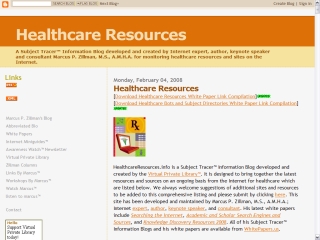
Healthcare Resources is a Subject Tracer™ Information Blog developed and created by the Virtual Private Library™ . It is designed to bring together the latest resources and sources on an ongoing basis from the Internet for healthcare.
Judicial Watch – Promoting Integrity, Transparency and Accountability in Government, Politics and the Law http://www.judicialwatch.org/
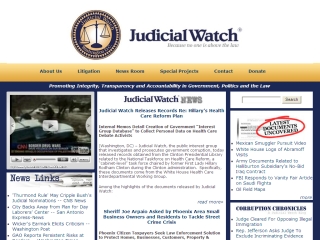
Judicial Watch, Inc., a conservative, non-partisan educational foundation, promotes transparency, accountability and integrity in government, politics and the law. Through its educational endeavors, Judicial Watch advocates high standards of ethics and morality in our nation’s public life and seeks to ensure that political and judicial officials do not abuse the powers entrusted to them by the American people. Judicial Watch fulfills its educational mission through litigation, investigations and public outreach. This has been added to Business Intelligence Resources Subject Tracer™ Information Blog. This has been added to Research Resources Subject Tracer™ Information Blog.
Management & Organizational History (M&OH) is a quarterly, peer-reviewed journal which aims to publish high quality, original, academic research concerning historical approaches to the study of management, organizations and organizing. The journal addresses issues from all areas of management, organization studies, and related fields. The unifying theme of M&OH is its historical orientation. The journal is both empirical and theoretical. It seeks to advance innovative historical methods. It facilitates interdisciplinary dialogue, especially between business and management history and organization theory. The ethos of M&OH is reflective, ethical, imaginative, critical, inter-disciplinary, and international, as well as historical in orientation.
This document lists acronyms, names and web addresses of over 1,560 leading research associations, university departments, institutes, networks, NGOs, organisations, periodicals, programs, information resources, and research projects of relevance to Asian & Pacific Studies. This has been added to Reference Resources Subject Tracer™ Information Blog.