WorldWide Telescope (WWT) is your ticket to the skies. From the comfort of a PC, WWT allows access to data from the world’s best ground- and space-based telescopes, blending terabytes of images and stories into a “seamless, immersive, rich media experience.” While much of the material is available on the site, the entire Windows application can also be downloaded for free. Teachers will appreciate Educator Resources (from the home page click Educators, and then WWT Ambassadors), where they can link to Getting Started in the Classroom, Classroom Resources, and WWT Tours with Lesson Plans. All readers will enjoy the boundless opportunities to tour distant galaxies, examine star explosions, and generally gawk at the majesty of the distant universe. This will be added to Astronomy Resources Subject Tracer™.
Scientists are scanning our solar system for asteroids with the Catalina Sky Survey. They need your help to find asteroids for the exploration of their mineral properties! The study of the asteroids helps us understand how planets and the basis for life form and evolve. Since no significant geological processes have taken place on these small bodies, the asteroids preserve a history of the Solar System in a way that the planets do not. These minor bodies contain relics of the conditions of the early Solar System. In 1994, Comet Shoemaker-Levy 9 slammed into Jupiter, leaving scars larger than the earth on the giant planet. We have evidence of other impacts on our planet, even within the last 100 years. As the events of February 15th, 2013 show in videos and photos from Chelyabinsk, Russia, occasionally one of the asteroids will impact our planet. Improving the detection efficiency of existing surveys is an excellent way to increase the number of asteroid detections. Asteroids may represent a resource that will bring the Solar System within humanity’s economic sphere of influence. These resources may be the key to unlocking human expansion from Earth into the Solar System, providing propellant for transportation, oxygen for breathing, water for hydration, shielding from solar radiation, and supporting other aspects of life and industry. In addition to these lifelines, asteroids provide the raw material for manufacturing in space, from iron, nickel and cobalt present in staggering quantities, to an abundant supply of the extremely useful and valuable platinum group metals. Just as resources have opened up the frontiers of Earth, they will again do so for the frontiers of space. There are asteroids out there, right now! Today, there are 644,632 known asteroids in the Solar System. This will be added to Astronomy Resources Subject Tracer™.
The above is the associated white paper link dataset compilation of the Astronomy Resources Subject Tracer™ Information Blog by Marcus P. Zillman, M.S., A.M.H.A. It is a 28 page .pdf document 248KB. [Updated on October 22, 2014] Other white papers are available by clicking here.
The above is the associated white paper link dataset compilation of the Astronomy Resources Subject Tracer™ Information Blog by Marcus P. Zillman, M.S., A.M.H.A. It is a 28 page .pdf document 247KB. [Updated on July 16, 2014] Other white papers are available by clicking here.
The above is the associated white paper link dataset compilation of the Astronomy Resources Subject Tracer™ Information Blog by Marcus P. Zillman, M.S., A.M.H.A. It is a 28 page .pdf document 249KB. [Updated on April 8, 2014] Other white papers are available by clicking here.
The above is the associated white paper link dataset compilation of the Astronomy Resources Subject Tracer™ Information Blog by Marcus P. Zillman, M.S., A.M.H.A. It is a 28 page .pdf document 246KB. [Updated on January 10, 2014] Other white papers are available by clicking here.
This is a second segment program highlighting my Subject Tracer titled Astronomy Resources. These resources cover the following areas: General Astronomy (general). AstroPhysics, BioAstronomy, Radio Astronomy and RoboScopes. These reources will have specific links identified to make these some of the very best sources available. We will also be reviewing the latest happenings from my blog during the last week. We will be also discussing my latest freely available Awareness Watch Newsletter V11N11 November 2013 featuring ShoppingBots and Online Shopping 2014 and my freely available November Zillman Columns titled Employment Resources on the Internet.
This program will highlight my Subject Tracer titled Astronomy Resources. These resources include astronomy resources in general, astrophysics, bioastronomy, radio astronomy and roboscopes. Learn where you can rent a telescope from all over the world and take pictures of various astronomical objects located throughout the universe!!! We will also be reviewing the latest happenings from my blog during the last week. We will be also discussing my latest freely available Awareness Watch Newsletter V11N10 October 2013 featuring Green Resources as well as my freely available October 2013 Zillman Column titled Artificial Intelligence Resources. You may call in to ask your questions at (718)508-9839. The show is live and thirty minutes in length starting at 2:00pm EDST on Saturday, October 12, 2013 and then archived for easy review and access. Listen, Call and Enjoy!!
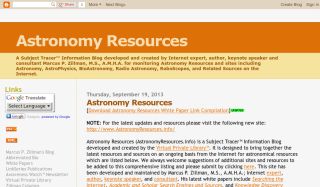
The above is the associated white paper link dataset compilation of the Astronomy Resources Subject Tracer™ Information Blog by Marcus P. Zillman, M.S., A.M.H.A. It is a 27 page .pdf document 266KB. [Completely Updated, Reviewed and Link Validated on September 19, 2013] Other white papers are available by clicking here.
While looking up at the night the sky, humans throughout the millennia have asked that age-old question: “What’s out there?” Stellarium provides entry into the world beyond Earth by offering this free open-source planetarium.The program includes over 600,000 stars, along with additional functionality that allows users to download data on over 210 million stars. Also, the program contains illustrations of the constellations and images of nebulae. The user interface is quite easy to use, as it gives users the ability to zoom in and out or use a fisheye projection as a way to experience a bit of that true planetarium feel. Also, the program offers users the ability to add new solar system objects from online resources and even create new effects, such as star twinkling and shooting stars. It is compatible with most operating systems. This will be added to Astronomy Resources Subject Tracer™ Information Blog. From The Scout Report, Copyright Internet Scout 1994-2013. https://www.scout.wisc.edu/