

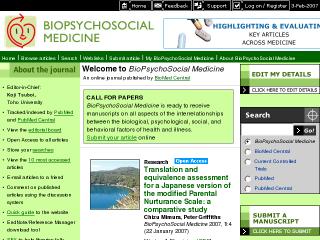
BioPsychoSocial Medicine
http://www.bpsmedicine.com/home/
BioPsychoSocial Medicine is an open access, peer-reviewed online journal that encompasses all aspects of the interrelationships between the biological, psychological, social, and behavioral factors of health and illness. BioPsychoSocial Medicine is the official journal of the Japanese Society of psychosomatic Medicine, and publishes research on psychosomatic disorders and diseases that are characterized by objective organic changes and/or functional changes that could be induced, progressed, aggravated, or exacerbated by psychological, social, and/or behavioral factors and their associated psychosomatic treatments. The journal emphasizes a bio-psycho-social approach to illness and health, covering the behavioral sciences, social sciences, neuroscience, stress physiology and epidemiology, psycho-neuro-endocrinology/ immunology, and psycho-oncology, all of which are associated with mind-body interactions. BioPsychoSocial Medicine considers the following types of articles:
* Research: reports of data from original research.
* Case reports: reports of clinical cases that can be educational, describe a diagnostic or therapeutic dilemma, suggest an association, or present an important adverse reaction. All case report articles should be accompanied by written and signed consent to publish the information from the patients or their guardians.
* Case studies: describe a major healthcare intervention, usually from a public health perspective. Case study articles that include a rigorous assessment of the processes and impact of the intervention as well as recommendations for future interventions will be considered favourably. Note that Case study articles should not describe an individual patient – authors should use the case report format for such descriptions.
* Reviews: comprehensive, authoritative descriptions of any subject within the journal’s scope. These are usually written by opinion leaders invited by the Editorial Board.
* Short reports: brief reports of data from original research.
* Letters to the Editor: they can take three forms: a substantial re-analysis of a previously published article, or a substantial response to such a re-analysis from the authors of the original publication, or an article that may not cover ‘standard research’ but that may be relevant to readers.
* Commentaries: short, focused and opinionated articles on subjects within the journal’s scope. These articles are usually related to contemporary issues, such as recent research findings, and are often written by leaders invited by the Editorial Board.