

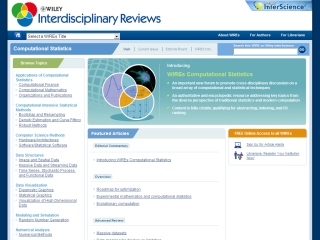
Computational Statistics: Wiley Interdisciplinary Reviews (WIREs)
http://www.wiley.com/WileyCDA/Section/id-390445.html
Wiley Interdisciplinary Reviews (WIREs) publications focus on high-profile research areas at the interfaces of the traditional disciplines.
* Content for each WIRE is selected, invited, and reviewed by an internationally renowned Editorial Board, ensuring that the highest scientific and presentational standards are maintained.
* Coverage is carefully crafted to provide an encyclopedic coverage of the field.
* New and updated reviews are added every month, ensuring that the most current information in the field is always available.
* Reviews are highly structured and consistently formatted, maximizing the accessibility and utility of the content to the user.
Article types are designed to cater to a variety of end users:
* Overviews provide a broad and non-technical treatment of important topics suitable for advanced students and for researchers without a strong background in the field.
* Advanced Reviews examine key areas of research in a citation-rich format suitable for researchers and advanced students.
* Focus Articles present specific real-world issues, examples and implementations.
* Opinions provide a forum for thought-leaders to offer a more individual perspective.
* Editorial Commentaries provide an opportunity for WIREs Editors to offer their own syntheses of broad areas of research in a less formal and more flexible style.
WIREs Computational Statistics is a major new scientific publication that will support the information needs of researchers in this field and help to shape its future development.
Its goals are to:
(1) present the current state of the art of Computational Statistics through an ongoing series of commissioned reviews written by leading researchers;
(2) capture the crucial interdisciplinary flavor of this field by including articles that address key topics from the differing perspectives of statistics and computing, and include potential application areas in technology, biology, physics, geography, and sociology;
(3) capture the rapid development of Computational Statistics through a systematic program of content updates; and
(4) encourage new participation in this field by presenting its achievements and challenges in an accessible way to a broad audience.